

About Shōendō
Preservation of Japanese Painting
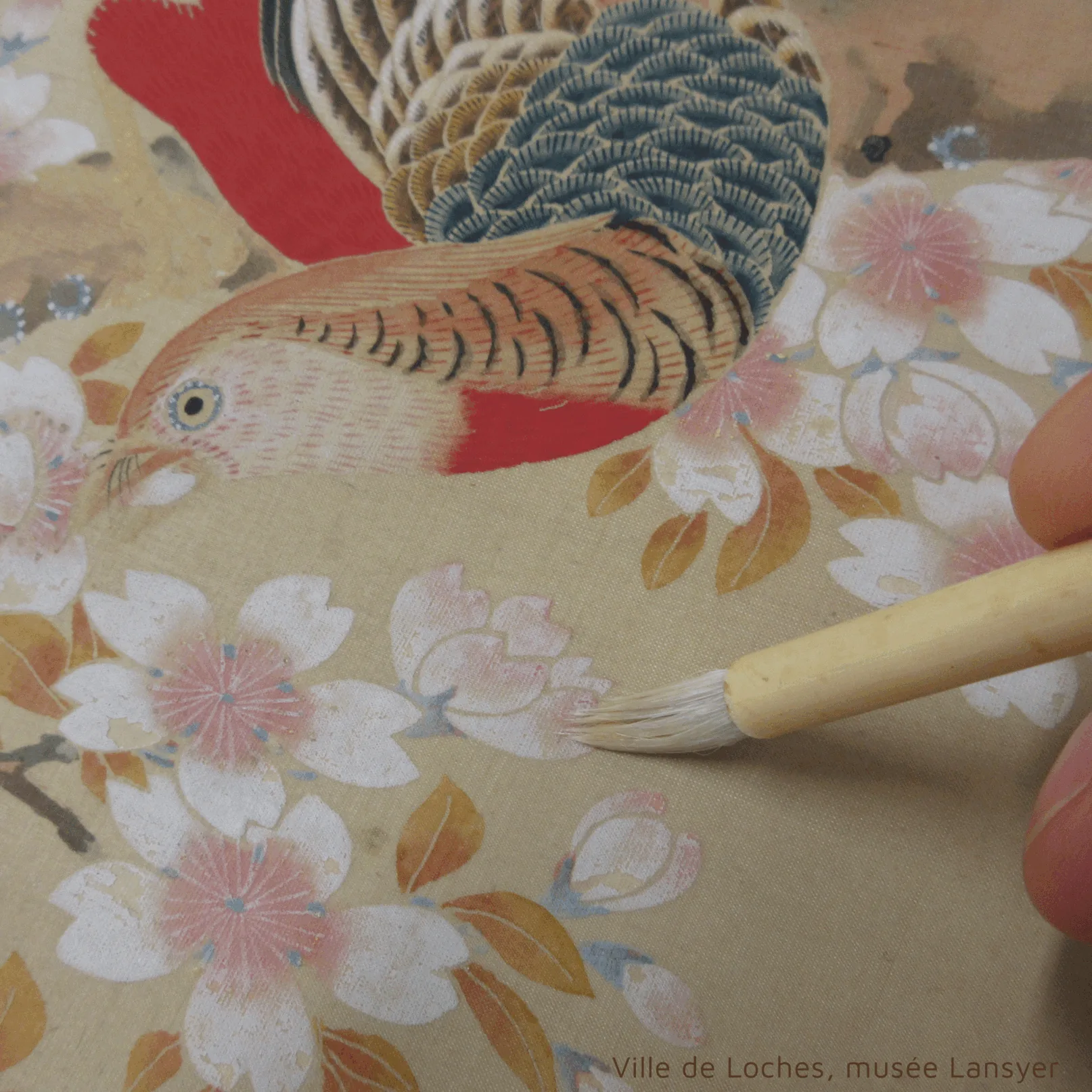
Based in France, the studio specializes in the conservation and restoration of Japanese paintings and other East Asian pictorial art.
The care for hanging scrolls –kakejiku-, folding screens –byōbu– or handscrolls –makimono– requires expert knowledge and hand skills that can only be achieved through long years of training. This is the type of excellence Shōendō offers to its clients all across Europe.
The name Shōendō (松燕堂) was born from training at Usami Shōkakudō (松鶴堂) in Kyoto. Following the tradition of inheriting one character from the master’s atelier, Shō (松, pine) was kept and paired with En (燕, swallow), echoing the crane (鶴) of Shōkakudō.
What we do
Traditional Japanese Craftsmanship, Contemporary Conservation Standards
Shōendō values the traditions of Japanese painting conservation, restoration, and mounting while remaining attentive to the latest technical advances and conservation standards.
The Shōendō studio recreates the environment of a Japanese conservation workshop. Work is primarily done on tatami mats and low workbenches, as this traditional setup provides the ideal conditions for these delicate tasks.
Shōendō uses only the finest materials, carefully selected from trusted Japanese makers and suppliers. These include various handmade washi papers, pure silk fabrics such as kinran — woven with gold thread — and donsu — damask — as well as other premium materials.. The adhesives employed in scroll and screen conservation—wheat starch paste, aged paste (furunori), seaweed glue (funori), and animal glue (nikawa)—are all natural materials with a long history of safe use in art conservation.
World-class Japanese conservation expertise, available in Europe.
Conservation Advisory & Technical Reports
Specialist Expertise Beyond the Studio
In addition to hands-on restoration work, Shōendō provides specialist advice and technical reports for collectors, galleries, auction houses, and institutions dealing with Japanese and East Asian paintings, remotely or on site.
Assessments may be based on direct examination or detailed photographic documentation and may address materials, structure, condition, mounting, and previous interventions.
Technical observations may also contribute to the understanding of a work’s possible period, history, or consistency with a proposed hypothesis. They do not constitute formal authentication, attribution, dating, or valuation.
Specialist knowledge for the decisions that matter.
The conservator
Yoan Rosenziveig
He has been fascinated by Japan and its culture since his youth. A passion for art and history led him to study at La Cambre (Brussels), where he obtained a Master’s degree in Paper Conservation and discovered how deeply Japanese materials and techniques have shaped Western practices.
Following his degree, he spent a year at the Boston Museum of Fine Arts, working alongside master conservators trained in Japan on the restoration of folding screens and scrolls. A Japan Foundation fellowship then brought him to Japan to deepen his language studies. He then joined the prestigious Usami Shokakudo studio in Kyoto, where he spent nearly eight years immersed in traditional Japanese conservation and mounting – refining his skills and working on countless pieces, both in the studio and at temples.
Drawing on this experience, he returned to Europe and founded Shōendō in 2025. As one of the very few fully trained experts outside of Japan, he offers European museums and collectors a standard of care that is otherwise out of reach.